Difficulty-Aware Rejection Tuning for Mathematical Problem-Solving
📝 Paper@arXiv | 🤗 Datasets&Models@HF | 🐱 Code@GitHub
🐦 Thread@X(Twitter) | 🐶 中文博客@知乎 | 📊 Leaderboard@PapersWithCode | 📑 BibTeX
DART-MathDART-Math datasets are the state-of-the-art and data-efficient open-source instruction tuning datasets for mathematical reasoning.
DART-Math-Hard contains ~585k mathematical QA pair samples constructed by applying DARS-Prop2Diff to the query set from MATH and GSK8K training sets, achieves SOTA on many challenging mathematical reasoning benchmarks. It introduces a deliberate bias towards hard queries, opposite to vanilla rejection sampling.
Performance produced by DART-Math-Hard is usually but not necessarily slightly better (~1% absolutely) than DART-Math-Uniform, which contains ~591k samples constructed by applying DARS-Uniform.
Most of previous datasets are constructed with ChatGPT, and many of them are not open-source, especially for ones of the best performance.
| Math SFT Dataset | # of Samples | MATH | GSM8K | College | Synthesis Agent(s) | Open-Source |
| :--------------------------------------------------------------------------------- | -----------: | -----------------------------------------------------------------: | ---------------------------------------------: | -----------------------------------------------------------------------------------------------------------: | :---------------------- | :-------------------------------------------------------------------------: |
| WizardMath | 96k | 32.3 | 80.4 | 23.1 | GPT-4 | ✗ |
| MetaMathQA | 395k | 29.8 | 76.5 | 19.3 | GPT-3.5 | ✓ |
| MMIQC | 2294k | 37.4 | 75.4 | 28.5 | GPT-4+GPT-3.5+Human | ✓ |
| Orca-Math | 200k | -- | -- | -- | GPT-4 | ✓ |
| Xwin-Math-V1.1 | 1440k | 45.5 | 84.9 | 27.6 | GPT-4 | ✗ |
| KPMath-Plus | 1576k | 46.8 | 82.1 | -– | GPT-4 | ✗ |
| MathScaleQA | 2021k | 35.2 | 74.8 | 21.8 | GPT-3.5+Human | ✗ |
| DART-Math-Uniform | 591k | 43.5 | 82.6 | 26.9 | DeepSeekMath-7B-RL | ✓ |
| DART-Math-Hard | 585k | 45.5 | 81.1 | 29.4 | DeepSeekMath-7B-RL | ✓ |
<sup>MATH and GSM8K are in-domain, while College(Math) is out-of-domain. Performance here are of models fine-tuned from Mistral-7B, except for Xwin-Math-V1.1 based on Llama2-7B. Bold/Italic means the best/second best score here.</sup>
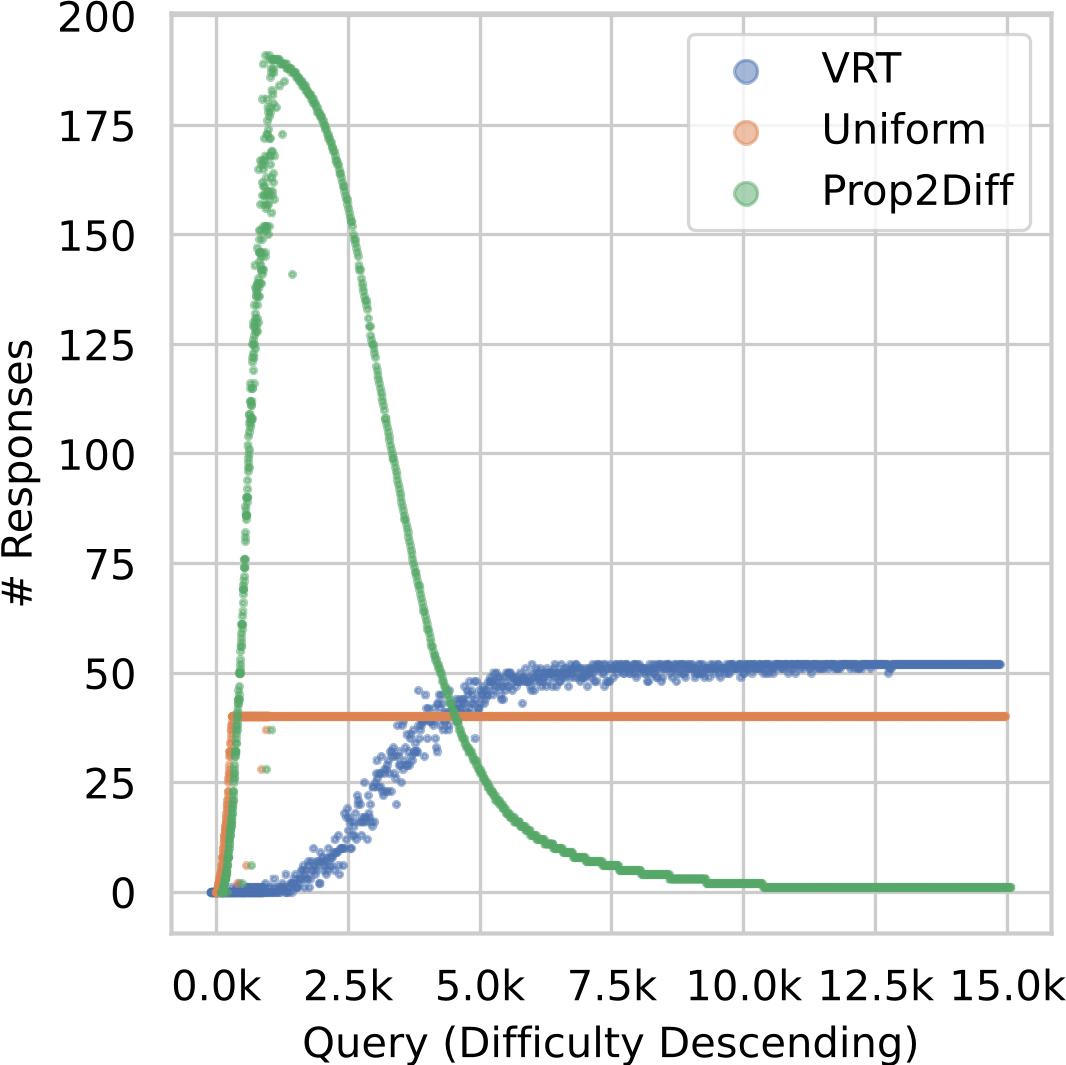
DARS - Difficulty-Aware Rejection SamplingPrevious works usually synthesize data from proprietary models to augment existing datasets, followed by instruction tuning to achieve top-tier results. However, our analysis of these datasets reveals severe biases towards easy queries, with frequent failures to generate any correct response for the most challenging queries.
Motivated by the observation above, we propose to Difficulty-Aware Rejection Sampling (DARS), to collect more responses for more difficult queries.
Specifically, we introduce two strategies to increase the number of correct responses for difficult queries:
See Figure 1 (Right) for examples of DART-Math-Uniform by DARS-Uniform and DART-Math-Hard by DARS-Prop2Diff.
If you find our data, model or code useful for your work, please kindly cite our paper:
@article{tong2024dartmath,
  title={DART-Math: Difficulty-Aware Rejection Tuning for Mathematical Problem-Solving},
  author={Yuxuan Tong and Xiwen Zhang and Rui Wang and Ruidong Wu and Junxian He},
  year={2024},
  eprint={2407.13690},
  archivePrefix={arXiv},
  primaryClass={cs.CL},
  url={https://arxiv.org/abs/2407.13690},
}